




Outdoor sconces vs. indoor wall lights: what are the essential differences

Lighting directly influences the atmosphere and functionality of your home. The right choice of sconces – those lighting fixtures that mount on the wall – can highlight architectural details, define spaces and contribute to safety. Do you want to know what technical and aesthetic characteristics make the difference between outdoor and indoor wall lights, so that you can customize the space exactly to your taste? In the lines below, discover the answers and find out how to choose the right type of applique according to the arrangement of the house.
Differences in function: interior vs. outside
Indoor applique supports visual comfort and contributes to atmosphere. You can find this type of lighting fixture in hallways, living rooms or bathrooms, where you can create discreet light scenes or accessorize an "accent wall" (a wall with a different color or texture from the rest of the room). For example, an applique mounted above the bed in the bedroom helps you read comfortably in the evening, and in a narrow hallway, an indirect light source can make the space seem more generous.
Exterior application emphasizes visibility and safety. This light fixture marks paths, highlights facade details and works great at the main access, on the patio or along entryways. For example, an application installed at the entrance of the house helps you find the key more easily at night and increases the feeling of comfort.
Other technical characteristics of indoor & outdoor wall lights: weather resistance and safety
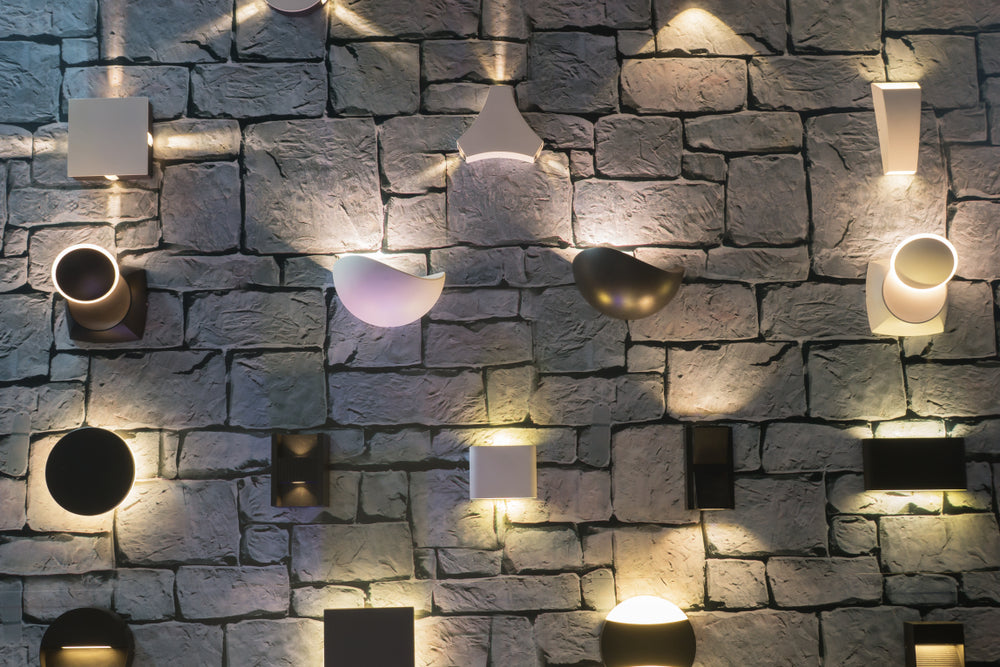
For outside, the sconces must withstand rain, dust and temperature variations. The IP (Ingress Protection) indicator shows the protection level of the equipment. For spaces exposed to splashes, choose models with IP44. If the appliques are mounted completely outdoors or on unprotected facades, opt for IP65, as it offers Fantas Aplica LED for Exterior and Interior – an example of a resistant and modern body.
Materials used for the exterior include aluminum, stainless steel and polycarbonate, as they tolerate exposure to the sun or rain. In the interior, designers often use glass, ceramics and metal with elegant finishes. In the bathroom or in spaces with high humidity, I recommend using high IP sconces, such as the dedicated models in this collection of wall sconces.
Comparative table
| Characteristic | Indoor sconces | Outdoor wall lights |
|---|---|---|
| IP protection | Minimum IP20 (bathroom: IP44) | Minimum IP44 - recommended IP65 |
| Materials | Glass, ceramic, metal | Aluminium, stainless steel, polycarbonate |
| Main function | Ambience, decor | Safety, guidance |
| Light source | LED, classic bulb | Mostly LED |
| Moisture resistance | Only for dedicated areas | Elevated |
Sconces: aesthetics and design integration
For interior design, sconces accentuate the style of the room. You can choose variants with geometric lines for a contemporary look, ornamental details for a classic decor or very simple models for minimalist spaces. For example, in a Scandinavian living room, an oval-shaped lamp and warm light emphasize the "hygge" style, focused on comfort and simplicity. By integrating these fixtures with decorative objects or with the room's color palette, you get a coherent result.
Outside, choose models that complement the architecture of the facade. There are vintage sconces for classic homes, industrial models for residences with modern lines or compact shapes for small spaces.
It is recommended to keep a stylistic consistency between indoor and outdoor lighting. For example, if you chose a minimalist decoration in the living room, the sconces for the terrace it could follow the same clear lines.
Installation and optimal positioning of indoor and outdoor sconces
inside, an aspect often ignored is the ratio between the height of the sconces and the level of the furniture. If you mount them too high in a room with a standard ceiling, the light becomes diffuse and lacks depth; too low, and long shadows distort the perception of space. Ideally, the center of the light source should be about 1.6–1.7 meters from the floor, but this rule should be adjusted according to the surrounding objects. For example, next to a bookcase or picture frame, sconces can be lowered 10–15 cm to emphasize textures without blinding the viewer.
in the bathrooms an important technical detail is the IP protection index: for areas exposed to splashes (such as near the shower or bathtub), IP44 or higher is recommended, otherwise there is a risk of short-circuiting or damage to the body. A common mistake is to mount sconces above the mirror, where the light falls vertically and accentuates the shadows on the face. The ideal position is to the side, at eye level, which provides even, natural light for activities such as makeup or shaving.
Also in the interior, it is worth mentioning the influence of the color of the walls on the perception of light. Glossy or very open walls can reflect the light excessively, and in this case wall lights with a matte diffuser or satin lampshade are recommended to avoid tiring reflections. Chandeliers vs. apply? What do we choose for each space in the house?
On the outside, installation requires special attention to environmental conditions. First of all, the distance from the ground must be respected, which varies according to the function: for the lighting of access ways, the sconces are mounted at 1–1.2 meters, while for facades or terraces, they rise to 2–2.2 meters. A rarely mentioned technical detail is the orientation of the body in relation to the source of rain and the direction of the wind – mounting on a wall directly exposed to the elements can shorten the life of the device if there is no minimal eaves protection.
The connection must be made with cables and special outdoor sockets with sealing gaskets, because condensation accumulated over time in ordinary bodies can cause oxidation and loss of electrical contact. In the case of mounting on wooden surfaces or heat-insulating materials, it is mandatory to have a metal or ceramic base for heat dissipation - a frequent mistake that significantly reduces the life of the LED bulbs.
Another aspect is how the beam is directed. Up-facing sconces provide a soft ambient light suitable for relaxing, while down-facing fixtures highlight architectural details or wall textures. Outside, double-beam (top-bottom) sconces are preferred for facades because they create a three-dimensional effect and highlight the vertical line of the building.
Modern technologies, efficiency and functionality
LED fixtures have become preferred both indoors and outdoors due to their low consumption and long life. You can opt for adjustable sconces in terms of light intensity or color, so that you can adapt the ambiance to the needs of the moment. For outdoor areas, wall lights with motion sensors increase energy efficiency, turning on only when they detect presence.
If you want to explore the differences between LED and traditional light bulbs, check this one out detailed analysis. For smart arrangements, you can choose models that can be controlled with the remote control or even from the phone.
How do you choose the right appliqué for your space?
Keep in mind:
- Location (indoor or outdoor)
- Protection level (IP)
- Materials – resistant to the environment or oriented towards aesthetics
- Favorite home style and design trends
- The available budget
If you want a flexible solution, explore options like Fantas Aplica LED, a model that fits in both areas. See the entire range of products adapted to any type of arrangement here.
Maintenance tips
- Clean the surface of the sconces periodically with a soft cloth, to keep the flawless appearance and the efficiency of the light;
- Check the tightness of the assembly outside, especially after winter or heavy rains;
- Use dedicated products for cleaning the glass, in the case of sconces with a transparent lampshade.
Careful maintenance ensures correct operation, but also the durability of the investment.
Discover the complete collection of wall sconces and enhance every space in your home, be it indoor or outdoor!
About the author