
Types of Light Bulbs

Editor principal
Share
The history of lighting it is fascinating. Among the first means of lighting we mention fire, torches, candles and candles.
Electric lighting it gained momentum in the 16-17 centuries, and since then the trend has been an upward one in terms of the advantages brought to users.
TYPES OF BULBS
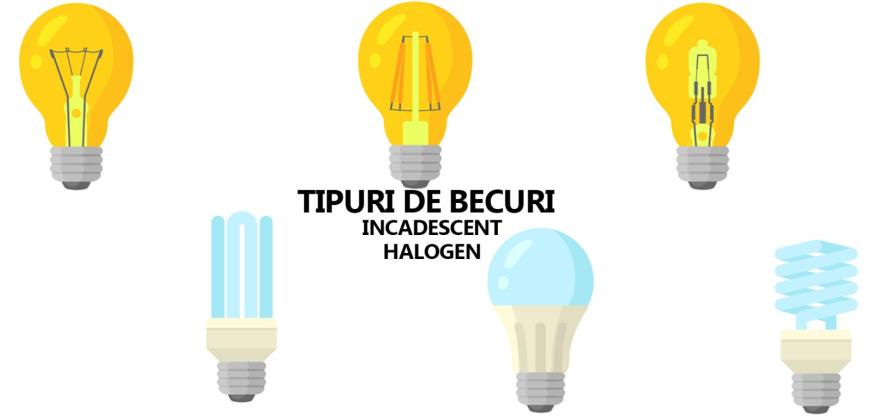
In the beginning there were incandescent bulbs, then halogen bulbs, after which the big leap was made economic bulbs compact, also known as CFL bulbs. LED technology has reached its peak in terms of artificial light, through efficiency, safety and maximum saving capacity.
-
Incandescent bulbs
Incandescent bulbs are those bulbs that we call "ordinary bulbs" or "classic light bulbs”.
Advantages
In their case, unfortunately, the advantages are not very many. Some still buy them because they fall into the category of cheap light bulbs. Others have their nostalgia for the simple fact that the color temperature of the light that I emit is a very pleasant one.
Disadvantages
Incandescent bulbs are not the most efficient the light source, because they have a very high energy consumption. To produce light, they must heat up. More precisely, the metal filament is heated by the electric current, and it emits light. A very small percentage (8%) of the energy consumed is transformed into light. One classic light bulb it can be seen, from this point of view, as a mini-radiator.
Besides the fact that they waste energy, incandescent bulbs have a short lifespan. Even if you pay a little at the time of purchase, they become very expensive over time. They have a durability of 1000-2000 hours and are totally uneconomical in the long term - an aspect that you must think about very carefully before deciding on these types of bulbs.
-
Halogen bulbs
Halogen bulbs are also incandescent bulbs, but they also contain a gas with halogen elements.
Advantages
They also illuminate by heating the incandescent filament, but they have a longer lifespan than classic bulbs, and color temperature is higher (2500K). They have one luminous flux of about 20 lumens/watt and emit white light, of a superior quality to ordinary light bulbs.
The halogen bulb can be a dimmable bulb, that is, in some models you can adjust light intensity. If you want one cheap lighting, halogen bulbs are good, but they are not a profitable investment.
Disadvantages
Even if they have a better energy efficiency than ordinary bulbs, they are not the best choice in this regard. In reality, a halogen bulb consumes 2-4 times more than an incandescent bulb economic bulb compact or one led bulb. And in terms of lifespan, it leaves much to be desired. It lasts on average 2000-3000 hours.
Halogen bulbs are suitable for spaces less frequented during the day, such as bathrooms, cellars, attics, cellars, where you don't have to turn on the light very often.
They are also an optimal choice for lamps.
-
Compact economic bulbs - fluorescent bulbs
Compact economical bulbs (CFL) work on the same principle as fluorescent bulbs. They contain mercury vapor and produce ultraviolet rays.
Advantages
Classic economic bulbs have the shape of a spiral, a tube or a rod. They are a cheap option for those who are looking economic bulbs. It consumes 75% less energy compared to incandescent bulbs and it is possible to find dimmable versions.
Disadvantages
Energy saving CFL bulbs are larger than incandescent bulbs. They light up gradually and you have to wait a while until they reach their maximum lighting capacity. They are not suitable for rooms where you turn the light on and off often. These bulbs allow between 100,000 - 600,000 ignitions and last around 8,000 - 15,000 hours, much longer than halogen bulbs.
-
LED bulbs
LED lighting is present in more and more homes, industrial and commercial units. Installation of economic leds in a home or in a company means a significant reduction in energy consumption and electricity costs.
What does LED mean?? This abbreviation comes from "light emitting diode" and translates as "light emitting diodes". The LEDs it generates light through a phenomenon called "electroluminescence", when the electric current passes through a semi-conducting material and emits a visible light.
LED technology is not from yesterday, from today. The first LED was developed in the 60s. Even from that time, the advantages of their use in terms of energy efficiency and durability were known. The second generation of LEDs appeared in the 90s, also when it started to be used in public lighting.
The companies sought to replace the fluorescent bulbs with LEDs at the outdoor advertising panels. The currently available LEDs are part of the 3rd generation.
Advantages
Some important features of these types of led bulbs:
-
increased resistance
-
considerable lifespan
-
maximum effectiveness
-
increased energy efficiency
-
low maintenance costs
-
financial savings
-
less residual light
-
better environmental performance
-
immediate maximum ignition
-
resistance to damage factors, falls or other shocks
-
they do not contain particles of mercury, lead or other toxic compounds
Disadvantages
If you decide to buy led bulbs for the home, you have to expect higher prices than other types of bulbs.
But this disadvantage will turn into a long-term advantage, because after you cover the purchase costs, you will have to pay less from the next invoice.
Another minus for LED bulbs is the fact that they spread the light in one direction. To avoid this, opt for lighting fixtures with more LEDs.
PARALLEL BETWEEN TYPES OF BULBS
If you switch from classic bulbs to economic lighting fixtures you only have to win. LED bulbs are considered the most economical bulbs. It is worth changing the old bulbs with economic leds because you save energy and money. The investment pays for itself in a relatively short time (1 year at 3 hours of consumption/day), and you can enjoy an optimally lit house with considerably lower bills.
More and more people are using modern LED lighting fixtures for interior and exterior. These light bulbs with low energy consumption they are extremely convenient in that they emit an increased amount of light, while the electricity consumption is lower than with standard bulbs. Replacing all lighting sources in your home or office with LEDs will bring you a 60-90% improvement in energy efficiency.
LED bulb equivalent to incandescent bulb in terms of power consumption is clearly in favor of the first category. LED bulbs consume almost 7 times less energy.
An incandescent bulb can last around 1,000 hours. An LED bulb lasts 50,000 hours and can reach up to 100,000 hours.
LED light it does not have to be changed annually. It has a lifespan of 6-12 years, that is 40 times longer than incandescent bulbs and 2-4 times longer than fluorescent bulbs.
LED bulbs operate at maximum capacity during winter or at low temperatures, compared to fluorescent bulbs, where the light intensity decreases in these conditions. For these reasons, LEDs are a smart choice for freezers and other cold spaces.
From the category of powerful led bulbs are part of the types of led 12W and 15W led bulbs. They have as much power as a 90W or 120W incandescent bulb.
TYPES OF SOCKETS
When you choose one light fixture, you have to choose one socket correspondingly. The socket is the support on which the bulb filament is placed. The good news is that some LED bulbs they are designed to fit the sockets used for classic light bulbs.
Sockets with thread:
-
Socket E24 it has the classic type of socket, with a large thread. Fits all types of bulbs: LED, halogen, economic, classic with filament, lamps. Most bulbs with this socket are powered at 230 V or 24 V.
-
Socket E14 it is also a classic socket, but with a smaller size of 14 mm. One e14 bulb it usually has 25 watts or 40 watts. This type of socket is used for decorative bulbs, for lamps and chandeliers, which have the shape of a candle. It can also be suitable for reflectors.
-
Socket E40 it is a threaded socket and has the largest size of all. It is intended for those powerful lighting fixtures which go up to 400W. We often find it in the types of outdoor lighting fixtures.
-
Socket E10 it is suitable for a portable lamp. You can also use it for a terrace lighting installation.
Sockets with bayonet:
-
B22. It is produced for LED bulbs, economical bulbs and halogen bulbs. It works at an electrical voltage of 230 Volts.
-
B22d. It is suitable for bright decorations from the outside.
-
GU10. It can be used for halogen bulbs and LED bulbs included in spotlights and hidden lighting fixtures (eg. recessed ceiling lamp).
Pine plinths:
-
G13. Corresponding to T8 led tubes.
-
T8. It is suitable for houses, workshops, garages, buildings.
-
G4. Corresponding to T5 led tubes.
-
T5. It is suitable for outdoor lighting, for aquariums or large stores.
-
2G7. This is produced for fluorescent lamps.
-
S14s. Corresponds to lamps and fluorescent tubes.
Other types of popular sockets:
-
G4 socket. It is used for LED bulbs and halogen bulbs that have a low voltage (12V), used to illuminate furniture, mirrors or ceilings.
-
G9 bulb socket. It is designed for halogen bulbs and G9 led bulbs, used in modern lighting fixtures, such as apply ceiling, ceiling lights, room lamp or small spots.
-
MR16 or GU,3. It is usually applied to LED or halogen spotlights. It is suitable for rooms with a high degree of humidity, such as the bathroom, kitchen or swimming pool.
-
GX53. Made for reflector bulbs and round flat bulbs. The type of led bulb GX53 it is used both indoors and outdoors.
Types of sockets suitable for LED bulbs:
-
E14
-
E27
-
G4
-
G9
Types of sockets suitable for lighting tubes with fluorescent LED bulbs:
-
G5 (T5)
-
G13 (T8)
If you have managed to go through the information to the end, you have definitely got an idea about which type of light bulb is right for you and which type of socket to choose. On alessandrodesign.ro - lighting fixtures online store - you can find an attractive offer of sconces, lamps, lighting lamps, ceiling lights, led chandeliers, chandeliers and chandeliers classics and others led products modern.
About the author
Editor principal
Autorul principal al blogului Alessandro Design, cu 88 de articole publicate. Scrie ghiduri practice de iluminat: cum alegi lustra în funcție de mărimea încăperii, cum instalezi corect un candelabru sau aplicele, cum întreții corpurile LED și cum funcționează cele dimabile.
Acoperă și zona de baie și accesorii — oglinzi, baterii sanitare din inox, idei de amenajare pentru balcon sau baie — plus subiecte utile clienților, cum ar fi dreptul de retur în Uniunea Europeană.